
Does the U.S. Have to Be a Tax Haven?
Reuven S. Avi-Yonah is the Irwin I. Cohn Professor of Law at the University of Michigan Law School. The author thanks Kenneth Austin, Patrick Martin, Hillel Nadler, and Karen Sam for helpful comments.
In this installment of Reflections With Reuven Avi-Yonah, Avi-Yonah argues that the United States would still be an attractive destination for foreign investment even if it imposed taxes on investors.

REUVEN S.AVI-YONAH
The United States is the world’s preeminent tax haven. Tax havens are defined as allowing secrecy and having low or zero tax rates; for nonresident aliens, the United States offers both.
The secrecy results from the fact that, in many U.S. states, it is possible to form a corporate entity without having to disclose information about the identity of the ownerThis situation is beginning to change because of the Corporate Transparency Act, but the law has been challenged as unconstitutional. Even this would only apply for U.S. government nontax purposes. A nonresident alien who uses a U.S. limited liability company to shield income from taxation in their home country would be able to rely on the secrecy provided by U.S. state law.
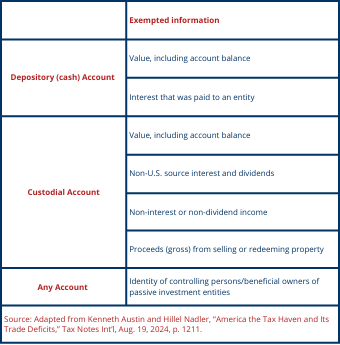
The Foreign Account Tax Compliance Act allows the United States to collect information from foreign countries about U.S. taxpayers under intergovernmental agreements negotiated by former President Obama’s administration; these IGAs are also supposed to help foreign governments tax their own residents on U.S.-source income. But as Kenneth Austin and Hillel Nadler explain in their excellent recent article, while some IGAs are nominally “reciprocal,” in practice, they leave a lot of information about non-U.S. taxpayers unaccounted for (see table). For example, reciprocal IGAs do not require the United States to share information regarding the controlling persons of entities used to hold passive investments. As a result, non-U.S. persons can avoid FATCA reporting by holding accounts with U.S. financial institutions through U.S. or foreign entities, like a Delaware or Cayman Islands LLC.
Information Not Required to Be Reported by U.S. Financial Institutions
Other countries responded to FATCA by adopting the common reporting standard (CRS). Unlike FATCA, which was adopted unilaterally and imposed on other countries by leveraging the importance of U.S. financial markets, the CRS was designed and implemented multilaterally. Under the CRS, all jurisdictions that agree to automatic exchange of information are required to share information with one another. Nearly all the major economies, including Brazil, the EU, India, the United Kingdom, and others — as well as traditional tax havens and financial centers like the Cayman Islands, Hong Kong, and Singapore — have adopted the CRS. As a result, non-U.S. financial institutions can no longer offer financial secrecy to their clients.
Today, the United States is the only established financial center that offers financial secrecy to nonU.S. persons. The U.S. financial industry opposes reciprocal reporting requirements. They assert that such requirements, if adopted, could increase compliance costs for U.S. financial institutions and might cause non-U.S. persons, including foreign tax evaders, to move funds out of the United States. Statements from financial industry representatives and their political allies make clear their belief that to attract foreign financial flows, secrecy is crucial. For example, the president of the Florida Bankers Association testified before Congress that there are hundreds of billions of dollars of foreign-held deposits in U.S. banks because “for more than 90 years the U.S. government has encouraged foreigners to put their money in U.S. banks by exempting these deposits from taxes and reporting.” Another group of lobbyists warned that reciprocal reporting by U.S. financial institutions would be “inconsistent with a century’s worth of Congressional precedence that has sought to make the U.S. economy an attractive destination for foreign capital."
The second element defining a tax haven is a low or zero tax rate. The U.S. offers abundant opportunities to earn U.S.-source income without imposing any withholding tax. In theory, fixed or determinable annual or periodic (FDAP) income from sources within the United States is subject to 30 percent withholding, but numerous exceptions swallow the rule.
The first (and perhaps most important) exception is for capital gains. Capital gains are not FDAP, and their source is the residence of the seller, so they are generally not U.S.-source if the seller is foreign. A foreign investor that invests in the stock of a U.S. corporation is therefore not taxed when they sell the stock.
The rationale for this exception is that it is impossible for the United States to impose a tax on capital gains if a foreign seller sells stock to a foreign buyer on a foreign exchange. That is true, but the scope of the exception is much broader. It applies, for example, to the sale of controlling interests in U.S. corporations, which the United States can tax because the buyer would want voting rights to exercise control. The United States can block the transfer of shares until the tax is paid. That is why many countries impose tax on the sale of large participations, and sometimes even on the sale of shares in foreign corporations that hold the shares of a domestic corporation, without a sale of the domestic corporation. The UN model tax treaty permits the residence country of the domestic corporation to impose such a tax on the sale of large participations, and many U.S. tax treaties permit it as well. This means that the United States is leaving money on the table by not collecting a tax it is permitted to collect under the treaty, while the treaty partner does collect on sales by large U.S. shareholders of their foreign corporations.
Also, the United States does not impose tax on stock buybacks by U.S. corporations, a typical way to distribute earnings. As I have argued previously, there is no reason not to impose a withholding tax on buybacks; the funds come from the United States so there is no administrability problem, and most buybacks from foreign shareholders (in other words, hedge funds) are from shareholders in non-treaty countries, so treaty limits on source taxation of capital gains do not apply.
There is one important exception to the lack of withholding on capital gains: gains on the sale of U.S. real estate or shares in U.S. corporations whose assets are mostly U.S. real estate. Even in this case, foreign investors can avoid the tax on their capital gains from the sale of real estate investment trust shares by investing through a domestically controlled REIT.
Capital gains are not subject to withholding under sections 871 and 881 because they are not FDAP. But the three major categories of FDAP, namely interest, royalties, and dividends, are also frequently not subject to withholding.
Most interest from U.S. banks and corporate borrowers is exempt from withholding, even though it is U.S.-source FDAP, under the portfolio interest exemption. There is an exception when Treasury determines “that the exchange of information between the United States and a foreign country is inadequate to prevent evasion of the United States income tax by United States persons,” but that has never been invoked and is unlikely to ever be invoked following the enactment of FATCA. Also, interest paid to 10 percent foreign shareholders (that is not portfolio interest) is frequently exempt under tax treaties because the U.S. model treaty provides for zero withholding on interest.
Royalties are also typically not subject to withholding because both the OECD and the U.S. model treaties provide for zero withholding on royalties, including royalties to related parties. Royalties to residents of non-treaty partners are subject to 30 percent withholding, but most royalties are paid to residents of treaty partners.
The key question is the extent to which U.S. treaties are immune from treaty shopping. As I have argued previously, the problem is that the United States rejects the primary purpose test that has been adopted by the rest of the world, instead relying on the limitations on benefits article that is found in most U.S. treaties. But there are still four treaties (with Greece, Pakistan, the Philippines, and Romania) that lack the LOB article. Even where there is one, the LOB is typically not difficult to plan around.
For example, an individual from a non-treaty country can set up a corporation in a treaty country and have it listed on a foreign exchange while retaining control. That corporation can enjoy zero withholding under the treaty because publicly traded corporations are exempt from the LOB. The IRS has been unsuccessful in arguing that when a foreign corporation in a tax haven licenses intellectual property to a holding corporation in a treaty country which, in turn, sublicenses it into the United States, the royalties from the holding corporation to the tax haven corporation are U.S.-source and subject to withholding.
This leaves dividends as the last major category of FDAP subject to withholding. Until 2010, withholding on portfolio dividends could be avoided by using total return equity swaps because, under a regulation adopted in 1991, payments on notional principal contracts (most derivatives) are sourced to the residence of the recipient and are therefore not subject to withholding because they are not U.S.-source. Meaning, a foreign investor could enter into a total return equity swap with a U.S. bank that would invest in the stock of a U.S. corporation, and every time the corporation paid a dividend, the bank would pay an equivalent dividend not subject to withholding. The enactment of section 871(m) closed this loophole in 2010, but because buybacks are not FDAP, there is no reason for a U.S. corporation to ever pay dividends to foreign portfolio shareholders since they can participate in buybacks without paying any tax. This may be a major reason for the dramatic increase in buybacks compared to dividend payments since 2003, even though for domestic taxable shareholders the dividend and capital gains rates have been the same.
Thus, the only category of FDAP that is likely to be subject to withholding is dividends to related parties, but even those are not subject to withholding under many U.S. treaties.
The lack of withholding can be seen in the IRS data from 2021. That year, total U.S.-source FDAP was $946 billion. Out of that, $816 billion (86 percent) was exempt, and only $129 billion (14 percent) was subject to withholding. The total amount of tax withheld was $22 billion, which amounts to a 2 percent effective tax rate on total FDAP, or a 16 percent ETR on FDAP subject to withholding, meaning a bit above the 15 percent treaty rate on portfolio dividends. Most of that withholding was in fact on dividends, which is ironic because dividends (unlike interest and royalties) are not deductible and therefore do not reduce the tax on the distributing U.S. corporation. In my opinion, imposing a withholding tax on dividends (and reinforcing it with a complex provision like section 871(m)) and not on interest or royalties is irrational.
Is This a Problem?
It certainly is a problem for the rest of the world, which is why there are complaints that the United States is a tax haven. Developing countries are suffering from capital flight because their elites can invest in the United States without being subject to any tax or information reporting. I argue it is a problem for the United States as well, because it is leaving tax revenue on the table for no good reason
The main argument for why the United States should not tax foreign investors or collaborate with exchanges of information to enable the investors’ countries of residence to tax them is that the United States needs the investment and if the United States imposed that tax or collected that information, the funds would simply flow elsewhere. That was the argument for enacting the portfolio interest exemption in 1984, as well as the various provisions like the qualified intermediary regime that ensure the IRS does not have access to information on beneficial ownership. But what was true then is not necessarily true now, for three reasons.
First, the United States is by far the most popular destination in the world for investment because of its relatively high growth rate, large markets, and relative political stability. Portfolio investment does not typically flow to developing countries because of their instability. The EU is stable but offers fewer investment opportunities because of its lower growth rate. Therefore, investors will likely continue to prefer the United States even if they were subject to a withholding tax. There was no decrease in foreign appetite for buying real estate in the United States after 1980 despite taxes being imposed on the capital gains.
Second, the rest of the world is subject to the CRS, so any investor in any other country must be concerned that their information may be shared with their home country. Even if U.S. investments are subject to 30 percent withholding (which would be rare because of the tax treaties), this is often lower than the individual income tax rate imposed by the investor’s home country, and there is less risk of the information reaching the home country. Therefore, investors are unlikely to move their funds from the United States to a country that is subject to the CRS (i.e., any other large country) even if they become subject to a withholding tax.
Finally, the United States certainly needs revenue, and imposing tax on FDAP can result in significant gains. 23 If the United States does so, the only comparable alternative for investors in terms of size and stability is the EU, which also does not impose tax on foreign investors under the savings directive and also needs the revenue. Therefore, the best solution would be for both the United States and the EU to impose a coordinated withholding tax on all outbound investment income. This can be imposed on all outgoing payments up front and only refunded or reduced upon proof that the investor is a bona fide resident of a treaty partner. The result would be significant revenue for both the United States and the EU and the imposition of some tax on the world’s rich.
Footnotes
1 Tax Justice Network, “Country Detail, United States” (2022). See Daniel J. Hemel, “The United States as the Ultimate Tax Haven: Testimony Before the House Ways and Means Subcommittee on Oversight,” Public Law and Legal Theory Working Paper Series No. 79 (2022).
2 See, e.g., Whizy Kim, “The Ultrarich are Getting Cozy in America’s Tax Havens at Everyone Else’s Expense,” Vox (Jan. 4, 2023); Nicole Sadek, “‘Delaware Is Everywhere’: How a Little-Known Tax Haven Made the Rules for Corporate America,” ICIJ (June 27, 2022); Oliver Bullough, “The Great American Tax Haven: Why the Super-Rich Love South Dakota,” The Guardian (Nov. 14, 2019).
3 National Small Business United v. U.S. Dept. of the Treasury, No. 24-10736; Andrew Velarde, “22 States Attack Transparency Act as Unconstitutional,” Tax Notes Int’l, May 27, 2024, p. 1389; Nana Ama Sarfo, “Eleventh Circuit Weighs the Corporate Transparency Act,” Tax Notes Int’l, Oct. 14, 2024, p. 233. See also Alan W. Granwell and Briahnna Skinner, “Application of the Corporate Transparency Act to Foreign Investors,” Tax Notes Int’l, Aug. 5, 2024, p. 843.
4 The Transparency Act also has many limits. For example, it does not impose reporting requirements on (1) accounts held at U.S. financial institutions; (2) less-than-25-percent beneficial owners; and (3) beneficial owners of trusts.
5 Kenneth Austin and Hillel Nadler, “America the Tax Haven and Its Trade Deficits,” Tax Notes Int’l, Aug. 19, 2024, p. 1211. See also Noam Noked and Zachary Marcone, “Closing the ‘Shell Bank’ Loophole,” 64(1) Virginia J. of Int’l Law 119-170 (2023); Patrick W. Martin, “The Need to Close the FATCA Loophole to Preserve the Integrity of U.S. Tax Enforcement Efforts,” Tax Notes Int’l, June 15, 2020, p. 1235.
6 Testimony of Florida Bankers Association President and CEO Alex Sanchez before the House Committee on Financial Services, Subcommittee on Financial Institutions and Consumer Credit (Oct. 27, 2011).
7 Letter from the Coalition for Tax Competition on sponsoring FATCA repeal (June 6, 2013).
8 Sections 871 and 881 (defining FDAP).
9 See Vodafone International Holdings B.V. v. Union of India, Civil Appeal No. 733 of 2012; S.L.P. (C) No. 26529 of 2010.
10 See Reuven S. Avi-Yonah, “Money on the Table: Why the U.S. Should Tax Inbound Capital Gains,” Tax Notes Int’l, July 4, 2011, p. 41.
11 See Avi-Yonah, “The Dividend Puzzle Redux,” Tax Notes Int’l, Mar. 25, 2024, p. 1815.
12 Section 897(h)(2).
13 Sections 871(h) and 881(c).
14 Section 871(h)(6).
15 Avi-Yonah, “Limitation on Benefits or Principal Purpose Test? Part 2,” Tax Notes Int’l, Aug. 12, 2024, p. 1033.
16 SDI Netherlands B.V. v. Commissioner, 107 T.C. 161 (1996).
17 See Avi-Yonah, “The Redemption Puzzle,” Tax Notes, Aug. 23, 2010, p. 853.
18 U.S. tax treaties with Australia, Belgium, Denmark, Finland, Germany, Japan, Mexico, New Zealand, Spain, Sweden, and the United Kingdom provide for zero withholding on direct dividends to parent corporations owning over 80 percent (50 percent for Japan) of the U.S. subsidiary. That also means that the branch profit tax rate is zero.
19 See IRS, Statistics of Income 2021, Foreign Recipients of U.S. Income Under Chapter 3 Withholding, Table 1, Forms 1042S: Number, Total U.S.-Source Income, and U.S. Tax Withheld, by Tax Treaty Countries and Total Non-Tax Treaty Countries, 2021; Recipients of U.S. Income Under Chapter 4 Withholding. Table 3. Forms 1042S: Number, Total U.S.-Source Income, and U.S. Tax Withheld, by Selected Income Types, 2021.
20 See Avi-Yonah and Wu, “Behavioral Biases and Political Actors: Three Examples From U.S. International Taxation,” in Behavioural Public Finance: Individuals, Society, and the State (2020).
21 See Tax Justice Network, supra note 1.
22 It also creates loopholes in FATCA that benefit U.S. persons. See Martin, supra note 5.
23 If a 30 percent tax were imposed on 2021 FDAP, the result would be revenue of $283 billion, although this would be both too high because it ignores the effect of tax treaties and behavioral impact, and too low because it excludes capital gains from buybacks.

Inscreva-se em nossa
newsletter
Veja também
A Primeira Seção do STJ afetou o Tema 1.273, discutindo o prazo decadencial para o mandado de segurança contra obrigações tributárias periódicas, buscando uniformização com força vinculante.
By Xiaoli Ortega | Tax Notes 27/11/2024
Nos Acompanhe


Instituto Brasileiro de Tributação e Tecnologia é referência em educação e debate sobre questões tributárias, oferecendo cursos e eventos especializados
Conecte-se ao IBTT
Apoio

Fale conosco
(+55) 11 4195 - 4949
Barueri - SP -Brasil
Edifício Guinzza
Al. Madeira, 258 – 4º andar
Cep: 06454-010.